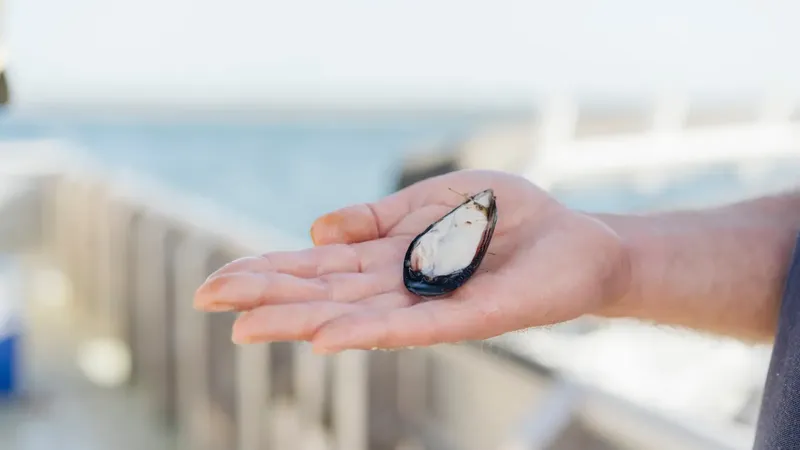
Two different animals
Green-lipped mussel (Perna canaliculus) is grown only in New Zealand. It is sold in pet stores as a freeze-dried powder, usually in tubs for dogs. Most of the published research on mussel powder for pets is on this species.
Blue mussel (Mytilus species; ours is Mytilus galloprovincialis) is farmed in many countries, including Australia, Europe and North America. It is the mussel most people eat. As a pet ingredient it is newer, and it has much less research behind it.
The head-to-head
The University of Newcastle analysed our blue mussel powder (Jervis Bay, Australia) and a leading New Zealand green-lipped powder in the same analysis, with the same methods:
| Measure | Blue mussel (Oyster Elements) | Green-lipped (leading NZ powder) |
|---|---|---|
| Total omega-3, g per 100 g | 4.83 | 3.33 |
| Phospholipid, % of lipid | 67% | 59% |
| Peroxide value, mEq O₂/kg (lower is fresher) | 3.4 | 7.7 |
Our blue mussel omega-3 breaks down as EPA 1.97 g, DHA 1.87 g, SDA 0.59 g, ALA 0.26 g and DPA 0.12 g per 100 g. Phospholipid-bound omega-3 is the form also found in krill. A lower peroxide value means less of the fat has oxidised, which matters for smell, taste and shelf life in pet food.
What this does not show
- It is one lot of each. It is a strong data point, not proof about every lot of every brand.
- It is not a joint-health result. Joint research is mostly on green-lipped mussel. We have no glycosaminoglycan data for blue mussel, and we make no joint claims for it.
- Label figures are not comparable across brands. Green-lipped labels typically declare 60 to 66% protein, 8 to 10% fat, 2 to 3.2% omega-3 and 2.4 to over 4% glycosaminoglycans. Those are manufacturer figures from different labs and methods.
Where each one fits
| Blue mussel | Green-lipped mussel | |
|---|---|---|
| Strengths | Higher omega-3 and phospholipid in head-to-head testing; lower oxidation; also brings B12 (60 µg/100 g) and taurine (1.1 g/100 g) | Name recognition with pet owners; most of the published research; established shelf presence |
| Claims | Composition only: protein, omega-3, phospholipid, B12, lot testing | Brands make joint-support claims based on the research, at their own regulatory risk |
| Supply | Farmed in many countries; ours from one Australian bay, lot-numbered | New Zealand only |
How pet brands are using blue mussel
As a whole-food marine ingredient: a topper or sprinkle, a front-of-pack ingredient in treats and chews, a shellfish component in raw diets, or a single-ingredient tub sold on its fatty-acid numbers. See how to use mussel powder in pet food for formats and inclusion arithmetic.
Full data and samples are on the mussel powder page.
Questions buyers ask
Is blue mussel as good as green-lipped mussel for dogs?
They are different. In one head-to-head analysis, blue mussel had more omega-3 (4.83 vs 3.33 g per 100 g), more phospholipid and less oxidation. Green-lipped mussel has most of the published joint research. No joint claims are made for blue mussel.
Does blue mussel contain glycosaminoglycans?
We have no glycosaminoglycan data for our blue mussel powder, so we make no claims about it.
Where does green-lipped mussel come from?
Green-lipped mussel (Perna canaliculus) is native to and farmed in New Zealand. Blue mussel (Mytilus species) is farmed in many countries; Oyster Elements blue mussel is rope-grown in Jervis Bay, Australia.