Who does what
| Step | Oyster Elements | You or your broker |
|---|---|---|
| Order and deposit | Quote with the current lot's COA; 50% deposit confirms the order | Approve the quote and spec |
| Production and testing | Produce, pack and test the lot; send the COA for that lot | Check the COA against your spec |
| Balance and release | Release once the balance is paid | Pay the balance |
| Freight | Hand over in Sydney with the shipping documents | Book air or sea freight and insurance from Sydney |
| US entry | Supply the facility and product details prior notice needs | Act as importer, file FDA prior notice, clear customs, pay duty |
| Supplier records | Provide documents for your FSVP file | Keep your FSVP for this ingredient and supplier |
FOB Sydney: what the terms mean
FOB (Free On Board) Sydney means our cost and responsibility end once the goods are handed over at the port of Sydney. Freight, insurance and everything after that are yours, which lets you use your own forwarder and broker. For air freight the equivalent term is FCA (Free Carrier) Sydney. If you'd rather have a delivered price, ask and we'll quote it to your address.
Air or sea for 50 to 250 kg
At these volumes the cost gap between air and sea is often smaller than buyers expect. Small sea shipments pay minimum less-than-container-load charges plus port and handling fees, while air is priced by weight. Sea usually adds several weeks in transit. Ask your forwarder for both quotes on your actual weight; many first orders go by air so a launch isn't waiting on a ship.
The documents that travel with each lot
- Certificate of Analysis (COA) for that lot: heavy metals (lead, cadmium, mercury, inorganic arsenic), microbiology and nutritionals, from accredited labs. Check that the lot number matches the bag (how to read an oyster powder COA).
- Product specification sheet.
- Commercial invoice and packing list.
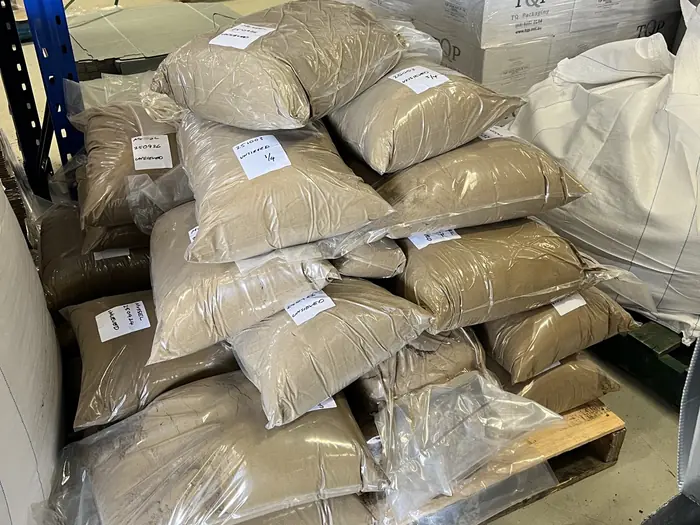
- Lot numbers on every bag, matched to the COA.
- Producing facility details for your prior notice and FSVP file. The producing facility is registered with the FDA; we send its registration details with your order.
Your FDA steps as the importer
FDA doesn't approve individual importers or shipments in advance. Food, including dietary supplement ingredients, can be imported without prior sanction, provided the producing facility is registered with FDA and prior notice is filed. Shipments can be examined at entry and held if they don't comply. (FDA)
Prior notice. It must reach FDA no less than 4 hours before arrival by air, or 8 hours by water. Anyone with the required information can submit it, and most brands have their broker or forwarder file it. (FDA prior notice guidance)
FSVP. The FSVP importer is the US owner or consignee of the food at entry. The importer keeps a written program for each food and each foreign supplier, covering hazards, an evaluation of the supplier and verification activities such as reviewing test records. Each entry line also needs the importer's name, email and a unique facility identifier, usually a DUNS number. (FDA FSVP rule)
If you make dietary supplements, check the reduced requirement. Importers who set and verify specifications for a dietary supplement component under the dietary supplement CGMP rule, or whose customer does, are exempt from most standard FSVP requirements (the customer route needs a written assurance). Your QA team probably sets those specifications already. (FDA FSVP rule)
If you make pet food, FSVP covers food for animals too, so the same program applies to a mussel or oyster ingredient for a topper or treat.
Duty: why we don't quote a number
Import duty on an Australian ingredient depends on how your broker classifies it and on US trade measures that have changed more than once in 2026. A figure we print today could be wrong by the time your lot lands. Ask your customs broker to confirm the classification and current duty before you order, and include it in your landed-cost model with freight and the customs processing fee.
Labelling the ingredient
Oyster and mussel are molluscan shellfish. Confirm the ingredient name and allergen wording for your market with your label reviewer before your packaging goes to print.
Questions buyers ask
Do I have to be the importer of record?
Under our FOB terms the US buyer, or an agent acting for them, is the importer. If you don't import directly, a customs broker or your contract manufacturer can act for you; agree who holds the FSVP before the first shipment.
Does FDA approve the shipment before it leaves Australia?
No. FDA doesn't pre-approve food shipments. It receives prior notice, may examine the shipment at entry, and can hold it if it doesn't comply.
How long from order to delivery?
Production and testing take 2–4 weeks from confirmed order. Add transit, which your forwarder will quote: air is a matter of days, sea is several weeks.
Can you quote a delivered price instead of FOB?
Yes. Send your delivery address and we'll quote delivered to your door.