An adult oyster filters tens of litres of seawater a day. That is why the meat is dense with minerals, and why any honest supplier has to talk about cadmium, lead, mercury and arsenic before the buyer asks. We covered what to test for earlier. This piece does the next step: turning a lab result into a per-serving number and comparing it with a real limit.
The limits that actually apply to a supplement
There is no single global “safe level” for a dried powder, and quoting a wet-seafood limit against a dried ingredient is the wrong comparison, because drying concentrates everything about nine-fold. The comparison regulators and QA teams use for supplements is daily intake per serving against a permitted daily exposure (PDE).
For oral products the widely used PDEs come from ICH Q3D and USP <232>:
- Cadmium: 5 µg per day
- Lead: 5 µg per day
- Inorganic arsenic: 15 µg per day
- Mercury: 30 µg per day
California's Proposition 65 sets tighter warning thresholds for two of them: lead 0.5 µg per day and cadmium 4.1 µg per day. Brands selling into California check those too.
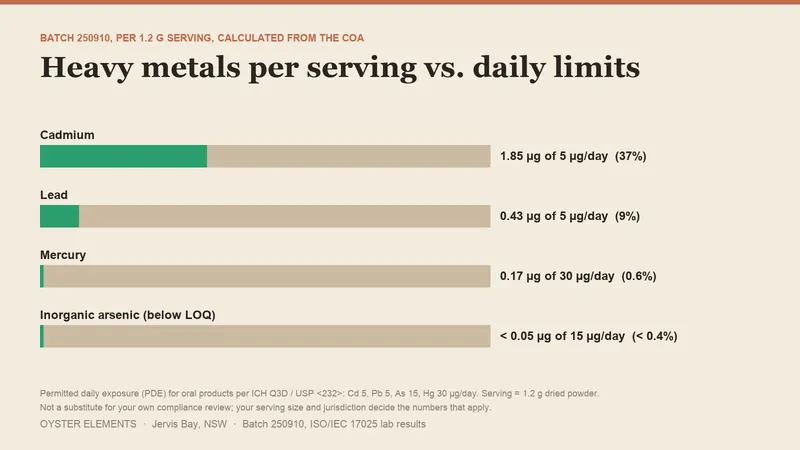
Batch 250910, per 1.2 g serving
The lab reports results in mg per kg of dried powder. Multiply by the serving weight in grams and divide by 1,000 to get micrograms per serving. For a 1.2 g serving:
| Metal | Lab result (mg/kg) | Per 1.2 g serving | PDE (ICH Q3D) | Share of PDE |
|---|---|---|---|---|
| Cadmium | 1.54 | 1.85 µg | 5 µg | 37% |
| Lead | 0.36 | 0.43 µg | 5 µg | 9% |
| Mercury | 0.14 | 0.17 µg | 30 µg | 0.6% |
| Inorganic arsenic | < 0.04 (below LOQ) | < 0.05 µg | 15 µg | < 0.4% |
| Total arsenic | 7.90 | 9.5 µg | — | Mostly organic arsenobetaine; see below |
Reading that honestly
Cadmium is the number. Bivalves concentrate it more than any other metal, and at 37% of the PDE from one serving it is comfortably inside the limit but not trivially so. A brand dosing three servings a day would sit above the PDE and should not do that with this or any oyster ingredient. We publish it rather than bury it because your QA team will find it anyway.
Lead is low. 0.43 µg per serving is under the Prop 65 daily threshold of 0.5 µg at one serving, and 9% of the ICH PDE. Two servings a day would cross the Prop 65 line, so a California label at higher dosing needs its own assessment.
Mercury is negligible. Oysters are low on the food chain; the 0.17 µg per serving is under 1% of the PDE.
Inorganic arsenic was below the limit of quantification. The lab cannot measure below 0.04 mg/kg, so the true value is somewhere under that. The total arsenic figure of 7.9 mg/kg looks alarming only until you know that in seafood it is overwhelmingly arsenobetaine, an organic form that is excreted unchanged. Any oyster COA that shows only total arsenic has not answered the question.
Where source water comes in
Testing catches problems; it does not create clean product. The reason lead and inorganic arsenic sit where they do is that these oysters grew on longlines in Jervis Bay, a protected marine region on the NSW south coast with no heavy industry upstream, under BAP-certified aquaculture and NSW Food Authority harvest-area classification. The lab confirms what the location earned.
Do the maths for any product
- Get the COA for the actual lot, with metals in mg/kg on the dried ingredient.
- Multiply each result by your serving weight in grams, divide by 1,000: that is micrograms per serving.
- Multiply by servings per day.
- Compare with the PDE for your market, and with Prop 65 thresholds if you sell in California.
- Make sure inorganic arsenic is reported separately, and that “<” values show the LOQ.
If a supplier cannot give you step one, the rest cannot be done, and that is your answer.
Questions buyers ask
Are oyster supplements safe to take?
It depends on the source water and on testing. Oysters are filter feeders and concentrate metals, cadmium above all. A safe product is one where the per-serving intake of cadmium, lead, mercury and inorganic arsenic sits inside the permitted daily exposure limits used for supplements. For Oyster Elements batch 250910, a 1.2 g serving delivers 1.85 µg cadmium (37% of the 5 µg/day PDE), 0.43 µg lead (9%), 0.17 µg mercury (0.6%) and under 0.05 µg inorganic arsenic.
How much cadmium is in oyster powder?
Batch 250910 of our whole oyster meat powder tested at 1.54 mg/kg cadmium, which is 1.85 µg in a 1.2 g serving, 37% of the ICH Q3D daily permitted exposure of 5 µg. Cadmium is the metal bivalves concentrate most, so it is the figure to check on any oyster COA.
Why does oyster powder show high total arsenic?
Seafood arsenic is mostly arsenobetaine, an organic form regarded as essentially non-toxic and excreted unchanged. The figure that matters for safety is inorganic arsenic, which in batch 250910 was below the laboratory limit of quantification of 0.04 mg/kg. A COA that reports only total arsenic has not answered the safety question.