Most oyster supplement pages stop at zinc. The lab does not. A full nutritional panel on dried whole oyster meat runs to protein, amino acids, fat and fatty acids, minerals and vitamins, and the interesting part is how they sit together. Batch 250910, per 100 g of powder and per 1.2 g serving:
Protein and amino acids
59.3 g protein per 100 g, with a measured amino acid total of 52.3 g. All nine essential amino acids are present: leucine 4.10 g, lysine 4.14 g, valine 2.36 g, isoleucine 2.18 g, threonine 2.61 g, phenylalanine 2.26 g, methionine 1.38 g, histidine 1.11 g, tryptophan 0.63 g per 100 g. Glutamic acid (7.93 g) and aspartic acid (6.05 g) lead the non-essentials, which is typical of shellfish and the reason oyster tastes savoury rather than fishy.
Per 1.2 g serving that is 0.71 g of protein. Nobody takes oyster capsules for protein; the point is that the protein is intact, which is what distinguishes a dried food from an extract.
Fat, and the omega-3 inside it
The powder is 11.8 g fat per 100 g. The split is unusual for an animal food:
- Polyunsaturated 44.9% (3,243 mg)
- Saturated 41.1% (3,134 mg)
- Monounsaturated 14.0% (1,051 mg)
Within the polyunsaturated fraction, omega-3 is 2,671 mg per 100 g, 37% of all fat: EPA 816 mg and DHA 1,150 mg. Omega-6 is only 500 mg, so the omega-6 to omega-3 ratio is roughly 1:5, the reverse of most modern diets. Trans fat is 58 mg, under 1%.
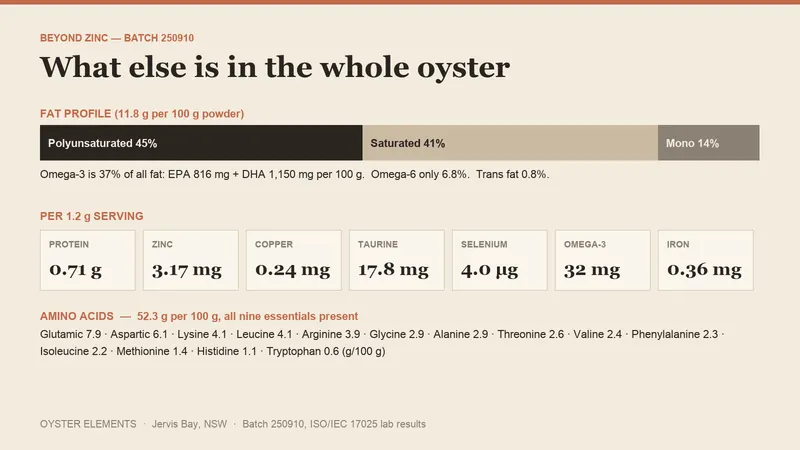
Now the honest part. Per 1.2 g serving, that is 32 mg of omega-3, about 10 mg EPA and 14 mg DHA. A fish-oil capsule carries ten to thirty times that. Oyster powder is not an omega-3 supplement and should not be labelled as one. What the figure tells a formulator is that the fat was not stripped out, which is what low-temperature drying of whole meat is supposed to achieve, and what a hot-water extract cannot.
Taurine
17.8 mg per 1.2 g serving, about 1.5 g per 100 g. Taurine is an amino sulfonic acid abundant in shellfish and largely absent from plant foods. There is no Daily Value for it. It is one of the compounds that survives water extraction, so it turns up in extracts too, but here it arrives with the rest of the matrix.
Minerals and vitamins per serving
| Nutrient | Per 1.2 g serving | % Daily Value |
|---|---|---|
| Zinc | 3.17 mg | 29% |
| Copper | 0.24 mg | 27% |
| Selenium | 4.02 µg | 7% |
| Iron | 0.36 mg | 2% |
| Niacin (B3) | 0.04 mg | < 1% |
| Taurine | 17.77 mg | No DV established |
Selenium at 7% DV is a modest but real contribution, and selenium in seafood is part of why the mercury story is less alarming than the raw number suggests. Iron and niacin are present at food levels and not worth building a claim on.
What this means for a label
- Lead with zinc and copper; they are the only nutrients above 20% DV at a two-capsule serving.
- Describe protein, omega-3, taurine and selenium as what the whole food contains, not as dose claims.
- Use the lot COA for the supplement facts panel. The figures above are batch 250910; natural ingredients vary, and we supply the panel for the batch you receive.
Questions buyers ask
Does oyster powder contain omega-3?
Yes. Batch 250910 of whole oyster meat powder contains 2,671 mg omega-3 per 100 g, 37% of its total fat, including EPA 816 mg and DHA 1,150 mg. Per 1.2 g serving that is about 32 mg, which is a whole-food amount rather than a fish-oil dose.
How much taurine is in oyster powder?
About 17.8 mg per 1.2 g serving, roughly 1.5 g per 100 g of powder, in batch 250910.
Is oyster powder a complete protein?
Batch 250910 is 59.3% protein with all nine essential amino acids present in its 52.3 g per 100 g amino acid profile. A 1.2 g serving supplies 0.71 g protein, so it is a complete protein source but not a meaningful protein dose at capsule quantities.