A Certificate of Analysis is the document that turns a claim into a measurement. For a whole-food marine ingredient it should cover identity, nutrition, contaminants and microbiology, and it should say who measured what, on which lot, when. Ours for batch 250910 runs to three pages and eight sections. This is what is in each, and what a QA reviewer looks for.
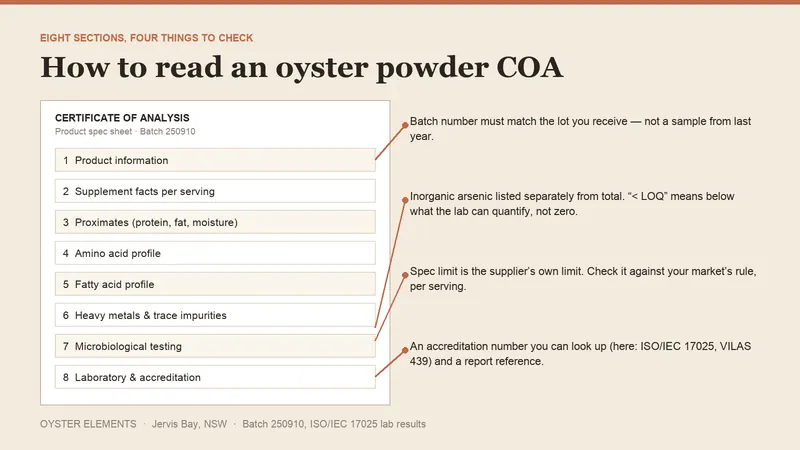
1. Product information
Product name, brand and legal entity, species in Latin (Magallana gigas and Saccostrea glomerata here), source (Jervis Bay, NSW), batch number, date tested, best-before, serving size, allergen statement (molluscs), storage, and the ingredient line. Ours reads “100% Australian oyster meat powder, whole food, no fillers, no additives.”
Check: the batch number on the certificate matches the batch on the bag you receive. A COA from a different lot is a brochure.
2. Supplement facts per serving
The nutrients a label will declare, per serving, with % Daily Value. Batch 250910 per 1.2 g: zinc 3.17 mg (29%), copper 0.24 mg (27%), taurine 17.77 mg, selenium 4.02 µg (7%), iron 0.36 mg (2%), niacin 0.04 mg.
Check: the serving size stated here is the one your product will use. If not, redo the arithmetic from the per-100 g figures.
3. Proximate composition
Protein 59.33 g, fat 11.81 g, ash 10.80 g, moisture 8.55 g, sugar under 0.5 g per 100 g, energy 3,816 kcal per kg, pH 6.37. This is the identity check for a whole-meat powder: protein near 60%, moisture under 10%. An extract on a carrier reads very differently, as covered in powder vs extract.
4. Amino acid profile
Eighteen amino acids listed individually, total 52.25 g per 100 g, all nine essentials present. Useful for anyone making a complete-protein statement, and a second identity check: the glutamic and aspartic acid dominance is characteristic of shellfish.
5. Fatty acid profile
Total fat broken into saturated, monounsaturated and polyunsaturated, with omega-3 (EPA 816 mg, DHA 1,150 mg per 100 g), omega-6 and trans fat reported. Extracts rarely include this section because there is little fat left to report.
6. Heavy metals and trace impurities
Total arsenic 7.90 mg/kg, inorganic arsenic below 0.037 mg/kg (below LOQ), cadmium 1.54, lead 0.36, mercury 0.14, each against a specification limit and a pass/fail. Selenium is reported here for information.
Check three things. First, inorganic arsenic appears as its own line; total arsenic alone is meaningless for shellfish. Second, “< LOQ” means below the limit of quantification, not zero; the LOQ should be stated. Third, the spec limit is the supplier's own limit. It is not a regulation. Convert the result to micrograms per serving and compare with the daily limit for your market, as shown in the safety article.
7. Microbiological testing
Total plate count 4.3 × 10³ cfu/g (limit 10,000), E. coli under 10 (limit 20), coliforms under 10 (limit 10), Staphylococcus aureus under 10 (limit 20). Marine ingredients dried at low temperature need this section; a high plate count is the first sign of a process or storage problem.
Check: results are for the dried powder, not the raw oysters, and Salmonella or Listeria testing is added where your market requires it.
8. Laboratory and accreditation
Laboratory name, accreditation standard and number (ISO/IEC 17025:2017, VILAS 439), report reference (UVN2541136), sample name matching the lot, date of receipt (16 October 2025) and date of report (28 October 2025), and a named approver.
Check: the accreditation number can be looked up on the accreditation body's register. A COA with a lab logo and no number is a design choice, not evidence. Independent means the lab is not owned by the supplier.
Where documents usually go quiet
- Total arsenic reported, inorganic arsenic missing.
- No LOQ, so “not detected” could mean anything.
- Nutritional panel present, contaminants “available on request.”
- A certificate dated a year or more before the shipment.
- No species, or a species that does not match the stated region.
- Microplastics: almost never tested. We report 0.00065% by weight for this lot from a separate laboratory annex, and we would rather have a number than a silence.
Questions buyers ask
What should an oyster powder Certificate of Analysis include?
Product identity with species and batch number, supplement facts per serving, proximate composition, amino acid and fatty acid profiles, heavy metals with inorganic arsenic reported separately and limits of quantification stated, microbiological results, and the testing laboratory's name, accreditation number and report reference.
What does 'below LOQ' mean on a COA?
Below the limit of quantification: the laboratory could not measure the analyte above its detection threshold. It is not the same as zero. The LOQ should be stated, for example inorganic arsenic below 0.04 mg/kg.
How do I verify a laboratory's ISO 17025 accreditation?
Look up the accreditation number on the accreditation body's public register. For batch 250910 the laboratory is Upscience Vietnam, ISO/IEC 17025:2017, VILAS 439, report UVN2541136.