Batch 250910 of our whole oyster meat powder tested at 2,641 mg of zinc per kilogram. Everything below follows from that one number.
The arithmetic
| Amount of powder | Zinc | % of US Daily Value (11 mg) |
|---|---|---|
| 1 g | 2.64 mg | 24% |
| One 500 mg capsule | 1.32 mg | 12% |
| One 600 mg capsule | 1.58 mg | 14% |
| 1.2 g serving (two 600 mg capsules) | 3.17 mg | 29% |
| 100 g | 264 mg | — |
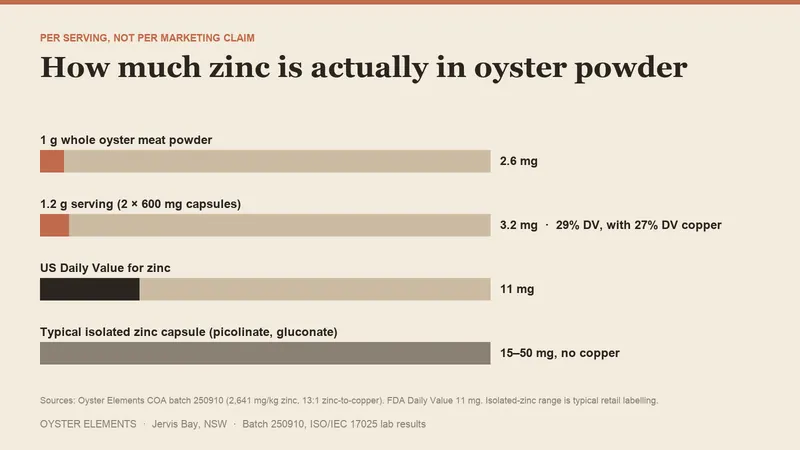
So a realistic two-capsule serving delivers about a third of the Daily Value. That is a food-level dose, and it is worth saying plainly, because some marketing implies an oyster capsule is a megadose. It is not. Its case rests on form, not on milligrams.
How the powder compares with raw oysters
USDA FoodData Central lists raw Pacific oyster (Magallana gigas) at about 16.6 mg of zinc per 100 g, and wild Eastern oyster at around 90 mg per 100 g. Species and water make a large difference. A raw oyster is roughly 85% water; drying to 8.5% moisture concentrates the solids about nine-fold, which is how 264 mg per 100 g of powder lines up with the raw figures for the species we grow.
Put differently: one gram of powder is close to one medium raw oyster's worth of zinc. A 1.2 g serving is a little more than one oyster.
Why the copper number matters
The same 1.2 g serving carries 0.24 mg of copper, 27% of its Daily Value. The ratio in the powder is about 13 parts zinc to 1 part copper. That is the ratio the oyster arrived with; nobody formulated it.
The reason buyers care: zinc and copper compete for absorption, and sustained high-dose isolated zinc is the classic way to run copper down. The US Upper Limit for zinc is 40 mg a day, and 50 mg picolinate capsules are common on shelves. Whole oyster sidesteps the problem by never separating the two minerals in the first place. It is a modest dose with its cofactor attached, which is a different product from a large dose without one.
Zinc per capsule for formulators
If you are building a label, the useful conversions are:
- 2.64 mg zinc per gram of powder (batch 250910; expect modest lot-to-lot variation, always use the COA for your lot).
- To label 25% DV per serving you need about 1.05 g of powder; 50% DV needs about 2.1 g, which is four 500 mg capsules.
- Copper scales with it at 13:1, so a 50% DV zinc serving lands near 55% DV copper. Both stay well under their Upper Limits (40 mg zinc, 10 mg copper).
Blends that pair oyster with grass-fed liver add copper from the liver side, which is worth checking before you set a serving.
What else comes with it
Zinc is the headline, not the whole story. The same serving brings 0.71 g of complete protein, 17.8 mg taurine, 4 µg selenium and 32 mg omega-3. Those are covered in the nutrients nobody mentions.
Questions buyers ask
How much zinc is in one gram of oyster powder?
About 2.6 mg. Batch 250910 of Oyster Elements whole oyster meat powder tested at 2,641 mg of zinc per kilogram, which is 2.64 mg per gram, 1.3 mg per 500 mg capsule and 3.2 mg per 1.2 g serving (29% of the US Daily Value).
Is oyster powder better than zinc picolinate?
They are different products. Zinc picolinate delivers far more zinc per capsule, typically 15 to 50 mg, at lower cost. Whole oyster powder delivers a food-level dose, about 3 mg per 1.2 g serving, with copper in a natural 13:1 ratio, complete protein, taurine, selenium and omega-3 alongside it.
What is the zinc to copper ratio in oyster powder?
About 13:1 in batch 250910: 3.17 mg zinc and 0.24 mg copper per 1.2 g serving. The ratio is natural to the oyster rather than formulated.