If you search for oyster supplements you will meet three different ingredients wearing similar names. Only one of them is the whole animal.
The three things sold as “oyster”
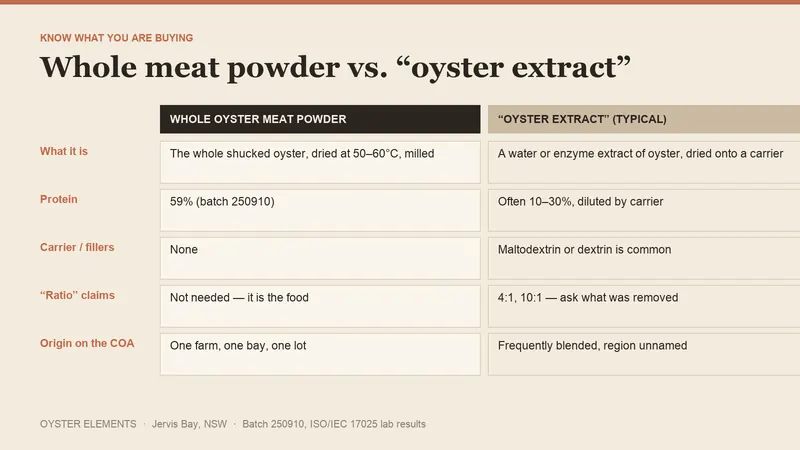
- Whole oyster meat powder. The shucked oyster, dried at low temperature and milled. Nothing removed, nothing added. Our batch 250910 is 59.3% protein because that is roughly what a dried oyster is.
- Oyster extract. Oyster meat that has been cooked in water or treated with enzymes, then the liquid fraction dried, usually onto a carrier such as maltodextrin so it flows and fills a capsule. Often sold with a ratio: 4:1, 10:1. The ratio tells you how much raw material went in, not what came out.
- Oyster shell powder. Ground shell, which is calcium carbonate. Cheap, legitimate as a calcium source, and nothing to do with the meat. It sometimes appears in “oyster calcium” products and occasionally, less honestly, in “oyster” blends.
Why the protein number gives it away
Dried oyster meat is mostly protein. Any whole-meat powder should land somewhere near 50 to 60 g of protein per 100 g, with fat around 10 to 12 g and moisture under 10%. Our batch 250910 reads 59.3 g protein, 11.8 g fat, 8.6 g moisture.
An extract that has been dried onto maltodextrin cannot get there. Maltodextrin is a carbohydrate. If a spec sheet shows 15 or 25 g protein per 100 g, you are looking at an ingredient that is mostly carrier, however good the oysters were. If the spec sheet does not show protein at all, ask why.
What an extraction actually removes
A water extraction pulls out the soluble fraction: some free amino acids, peptides, minerals, taurine. It leaves behind, or degrades, most of the structural protein, the fat (and with it the omega-3 EPA and DHA), and the fat-soluble compounds. Heat does the rest. That is why an extract can be “standardised to zinc” and still carry very little of what made the oyster interesting.
Whole meat powder keeps the matrix intact: zinc alongside its copper cofactor at a natural 13:1 ratio, a complete amino acid profile at 52 g per 100 g, omega-3 at 2.7 g per 100 g, taurine, selenium. The trade-off is honest: the zinc concentration per gram is lower than in an isolate, because the gram is still food.
Five questions that separate them
| Ask | Whole meat powder answers | Extract answers |
|---|---|---|
| What is the protein per 100 g? | 50–60 g | Usually well under 30 g |
| Is there a carrier? | No | Maltodextrin, dextrin, rice flour |
| What ratio? | None; it is the food | 4:1, 10:1, 20:1 |
| Which species, which water? | Named, single origin | Often blended, region unnamed |
| Can I see the COA for my lot? | Yes, before you order | Sometimes a generic sheet |
Which one should a brand use?
If the product is positioned as a whole-food or ancestral supplement, only the whole meat is defensible. The label says oyster; the capsule should contain oyster. If a formulator simply wants a zinc number at the lowest cost per milligram, an isolated zinc salt will beat both powder and extract, and it is more honest to say so than to dress an extract up as a food.
The one place extracts make sense is where a very small capsule needs a concentrated soluble fraction. Even then, the buyer should know what was left out.
Questions buyers ask
Is oyster extract the same as oyster powder?
No. Oyster meat powder is the whole shucked oyster, dried and milled, with nothing removed or added. Oyster extract is a water or enzyme extract of the meat, usually dried onto a carrier such as maltodextrin and sold with a concentration ratio like 4:1 or 10:1.
How can I tell if an oyster supplement uses whole meat or an extract?
Check the protein figure on the specification sheet. Dried whole oyster meat is roughly 50 to 60% protein. An extract dried onto a carbohydrate carrier is usually well under 30% protein. Also ask whether a carrier is used and whether the species and growing region are named.
Does oyster extract contain omega-3?
Very little. Water extraction leaves most of the fat, including the omega-3 EPA and DHA, behind. Whole oyster meat powder retains it; batch 250910 of our powder contains 2,671 mg of omega-3 per 100 g.